Skip to Main Content
TTR and TTCI as New Industry Metrics for Evaluating
Time-Efficient Anxiety Relief – With CalmiGo as a Leading Example
Executive Summary
In an era where the prevalence of anxiety disorders are rising rapidly, reliable solutions are in demand. Conventional evaluation tools like GAD-7 and STAI provide reliable symptom tracking but lack the ability to measure how quickly and efficiently an intervention works. This whitepaper introduces two novel, complementary metrics that can serve as new industry standards for evaluating the impact of anxiety relief interventions: Time to Relief (TTR) and Time to Calm Index (TTCI). These metrics are applicable across pharmacologic, behavioral, and device-based solutions.Using CalmiGo as a case study, we demonstrate how these metrics can enable meaningful comparison and guide both clinical and consumer decision-making.
Definitions
Time to Relief (TTR):The average time (in minutes) it takes for a user to begin experiencing noticeable symptom relief after initiating an intervention during acute anxiety, panic, or PTSD episodes.
Time to Calm Index (TTCI):
A measure of time-efficiency: the number of GAD-7 points reduced per minute of total active use over a defined period (e.g., 2 weeks). This index reflects not just efficacy, but how quickly an intervention delivers measurable benefit.
Why These Metrics Matter
Traditional outcome measures focus on symptom severity (e.g., GAD-7, STAI) but ignore:- Onset speed of symptom relief
- Total time investment needed for improvement
- Real-world adherence and training time.
TTR and TTCI provide: - Immediate impact analysis (TTR) - Efficiency normalization across various modalities (TTCI)
TTCI Calculation Overview
Before presenting the results, it is important to explain how the Time To Calm Index (TTCI) is calculated.TTCI Formula:
> TTCI = GAD-7 reduction / Total minutes of active use.
This allows us to quantify the efficiency of each intervention in reducing anxiety symptoms, normalized by the time users actively engage with the solution. Total use time includes direct usage and, for behavioral interventions, estimated training or onboarding time.
Example (CalmiGo):
> GAD-7 reduced by 4.64 points over 84 minutes (2 sessions/day for 2 weeks @ 3min each) > TTCI = 4.64 / 84 = 0.0552
CalmiGo’s Performance
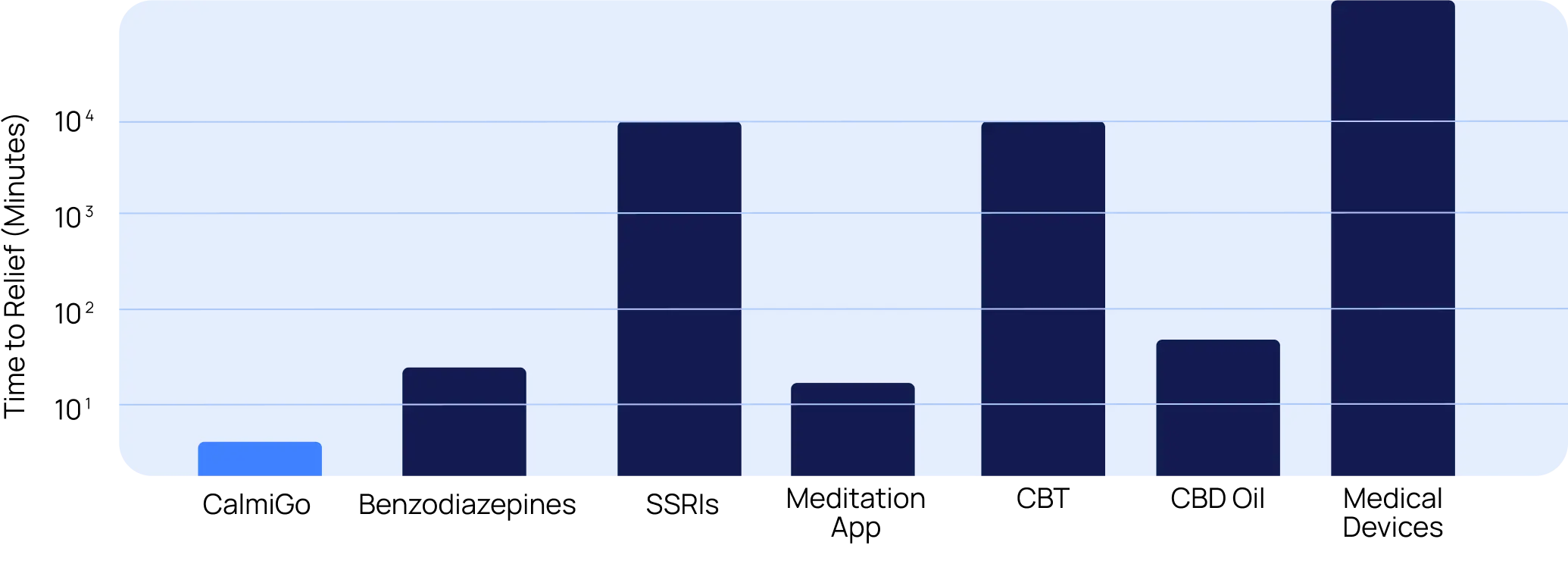
Using CalmiGo as a case study, we can demonstrate how these novel metrics (TTR and TTCI) can be applied in practice, allowing direct comparison with other clinical and consumer solutions.- A. TTR: Fastest Time to Relief
- CalmiGo: ~3 min
- Benzodiazepines: 15–30 min
- SSRIs: Days–weeks
- Meditation Apps: 10–15 min (after training)
- CBT: Days–weeks
- CBD Oil: 20–45 min
- Medical Devices (average of Freespira, Alpha-Stim CES): ~37 days for significant improvement
- Freespira: ~28 days for panic attack elimination
- Alpha-Stim CES: ~6 weeks for significant improvement
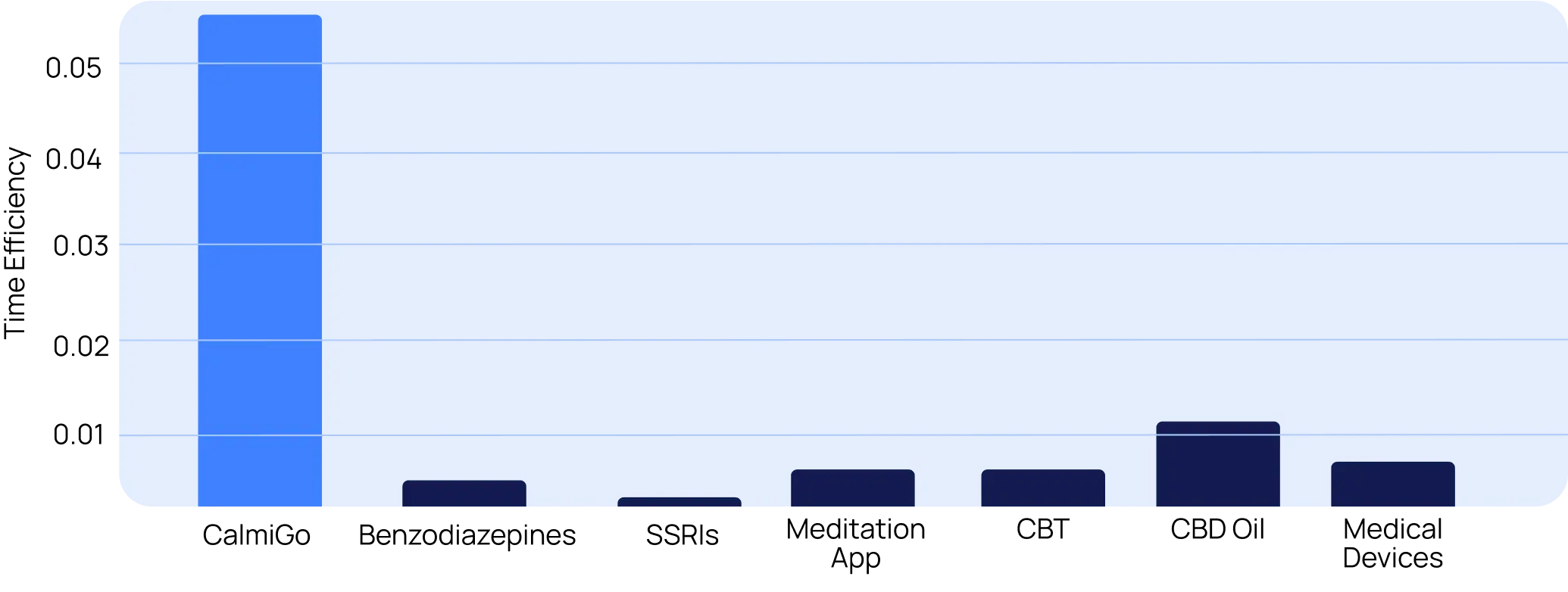
- B. TTCI: Highest Time Efficiency
- CalmiGo: 4.68 GAD-7 points over 84 min → 0.0552
- SSRIs (sertraline): ~0.00045–0.0010 (6-week data)
- Benzodiazepines (alprazolam, HAM-A proxy): 0.00108 (see Appendix C)
- Meditation (adj.): 0.005
- CBT (adj.): 0.0053
- CBD Oil: 0.0119
- Medical Devices (average of Freespira TTCI–PDSS, Alpha-Stim CES GAD-7 & HAM-A): ≈ 0.0048
- Freespira: ~8.8 PDSS points over 952 min → 0.0093 (TTCI–PDSS)
- Alpha-Stim CES (GAD-7): ≈ 0.0016
- Alpha-Stim CES (HAM-A): ≈ 0.00345
TTR: Time to Relief
TTCI: Time to Calm Index (Highest Time Efficiency)
Conclusion
TTR and TTCI represent a new frontier in how we evaluate anxiety interventions. By introducing standardized ways to measure the speed and efficiency of symptom relief, these metrics empower healthcare providers, researchers, and consumers to makebetter-informed choices.
CalmiGo serves as a powerful demonstration of what a high-performing solution looks like when evaluated through this lens.
But the broader vision is for TTR and TTCI to become industry-wide benchmarks, applicable to any product or therapy claiming to reduce
anxiety symptoms.
- Appendix A: Assumptions for TTCI
- CalmiGo: 2 sessions/day × 3 min × 14 days = 84 min
- SSRIs: Daily dosing; effect window assumed 8–12 h/day for calculation
- Meditation: 15 min/day × 20 days + 900 min training = 1,200 min
- CBT: 60 min/week × 12 weeks + 600 min homework = 1,500 min
- CBD Oil: 15 min/day × 28 days = 420 min
- Medical Devices (average): Mean of Freespira (952 min), Alpha-Stim CES (2,520 min)
- Appendix B: Sourced Changes
- CalmiGo: Company-reported user data: −4.68 GAD-7 points in 2 weeks
- SSRIs: PANDA trial, sertraline, ~−3.9 points at 6 weeks
- Meditation: RCT, Insight Timer, −4.7 points in 30 days
- CBT: NHS IAPT data, ≥4 points improvement = reliable change
- CBD Oil: RCT, significant GAD-7 reduction vs waitlist
- Freespira: PDSS drop ~8.8 points in employer-based pilot
- Alpha-Stim CES (GAD-7): Open-label real-world cohort, ~4-point drop at 6 weeks
- Alpha-Stim CES (HAM-A): Late-life GAD study, −8.7 points at 6 weeks
- Appendix C: TTCI–HAM-A for Benzodiazepines
- Alprazolam (GAD, 4-week RCT):
Baseline ~24.8; −10.9 HAM-A points; 6 h/day × 28 days = 10,080 min → 0.00108 points/min - Clonazepam (panic disorder, 8-week RCT):
Baseline 11.9; −1.4 HAM-A points; 12 h/day × 56 days = 40,320 min → 0.000035 points/min
References
- 1.PANDA trial: Lewis G et al., The Lancet Psychiatry, 2019.
- 2.Insight Timer meditation RCT: O’Callaghan et al., JMIR Formative Research, 2023.
- 3.NHS IAPT outcomes framework, 2020.
- 4.CBD RCT: Moltke J et al., Frontiers in Psychiatry, 2021.
- 5.Alprazolam RCT: Ballenger JC et al., Arch Gen Psychiatry, 1988.
- 6.Clonazepam RCT: Nardi AE et al., J Clin Psychopharmacol, 2008.
- 7.Freespira employer-based pilot: Tolin DF et al., Journal of Clinical Psychiatry, 2017.
- 8.Alpha-Stim CES (GAD-7): Real-world open-label cohort, 2025.
- 9.Alpha-Stim CES (HAM-A): Shekelle PG et al., Journal of Affective Disorders, 2024.